How to Talk to Pit Judges Training Module
Judges are trying to understand your team quickly
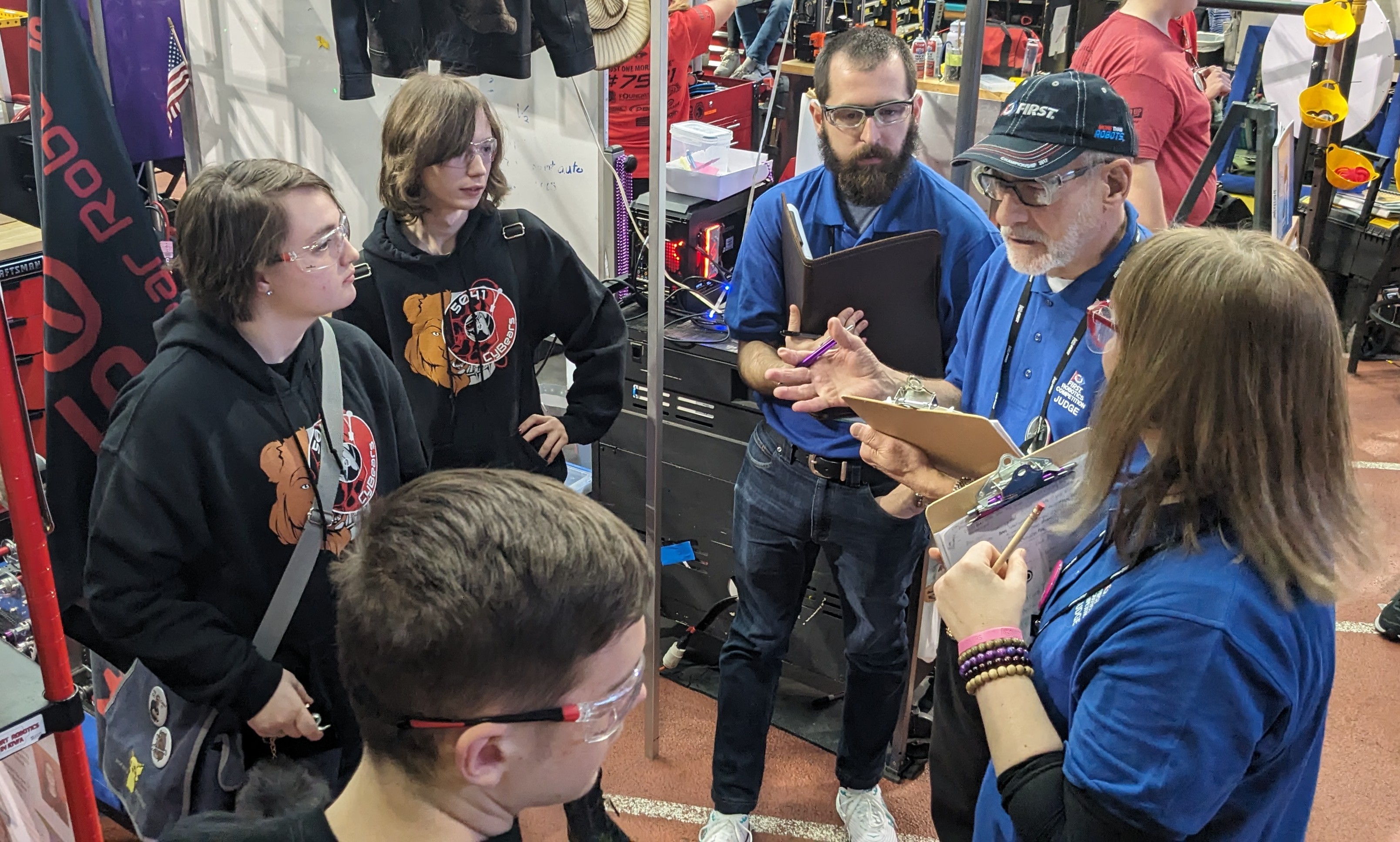
What judges need
- Clear student explanations.
- Specific evidence they can write down.
- Examples from the robot, pit, field, or team history.
- A short story that connects to an award area.
- Respectful, focused, honest conversation.
Judges are ambassadors, role models, detectives, and reporters
Ambassador
They represent FIRST and encourage students.
Role Model
They may be a student’s first connection to a STEM professional.
Detective
They gather evidence about teams and robots.
Reporter
Their notes help create award scripts.
Student takeaway: judges need memorable details they can explain later in deliberations.
This module does not cover submitted awards
Covered here
- Pit conversations
- Machine awards
- Team attribute awards
- Mock judge interactions
- Short student talking points
Not covered here
- FIRST Impact Award submissions
- FIRST Impact interview room
- FIRST Leadership Award submissions
- Submitted essays or formal presentations
- Prepared presentation scoring
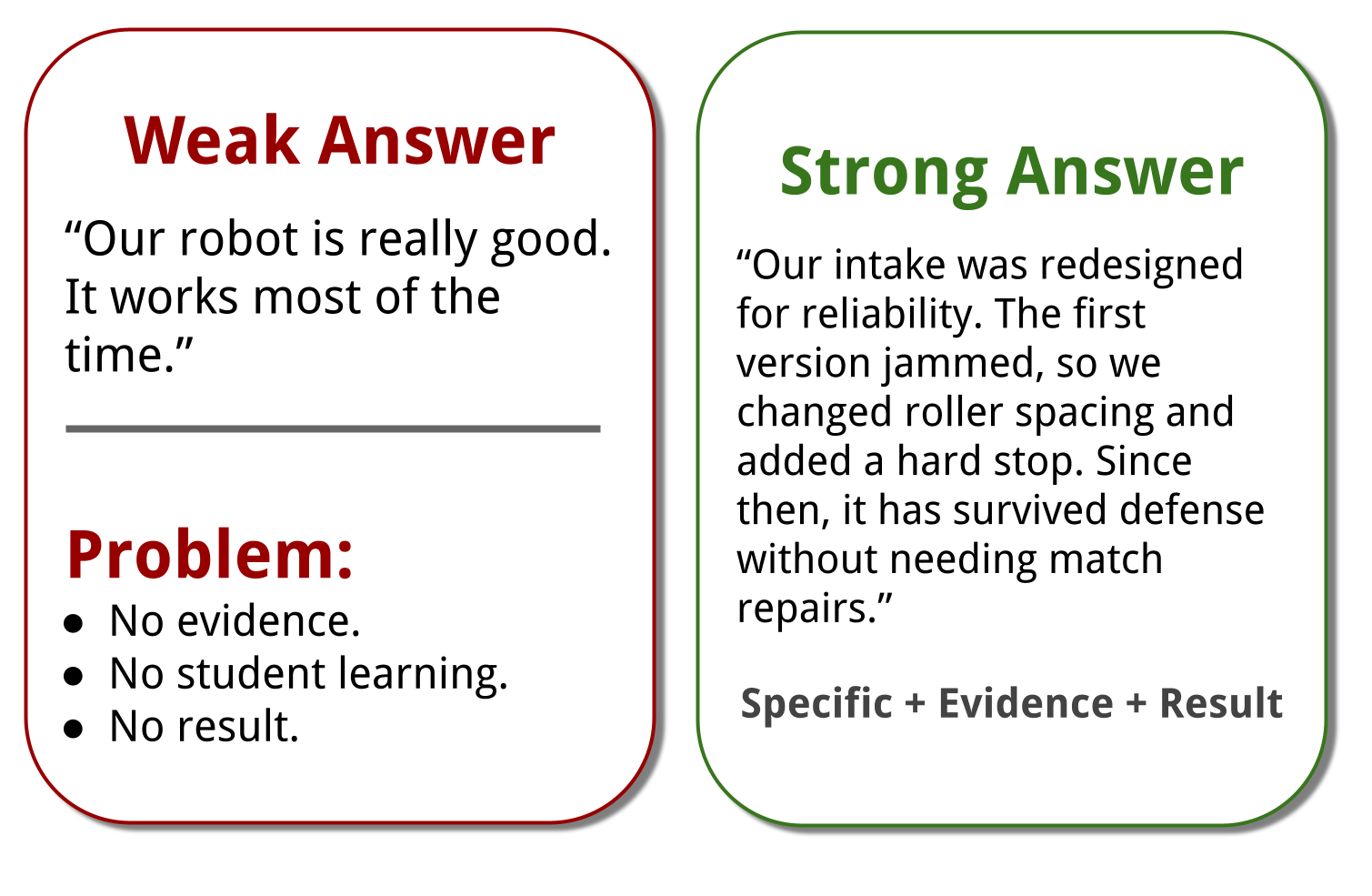
Turn vague claims to evidence-based
A strong opening makes judges comfortable
Useful opening
“Hi, welcome to Team 5041. I’m ___, and I worked on ___. We can talk about the robot, strategy, programming, outreach, safety, or team sustainability. What would you like to know first?”
Welcoming
It gives judges a clear starting point.
Student-led
It shows student ownership right away.
Flexible
It lets judges ask what they came to learn.
Answer first, then guide
Avoid
- Ignoring the question.
- Starting a memorized speech.
- Talking over teammates.
- Giving every detail at once.
- Handing over a giant binder.
Do
- Answer the question asked.
- Keep the first answer short.
- Offer deeper detail if asked.
- Use the robot as evidence.
- Bring in the right teammate.
Judges have a job to do and limited time. Help them get the information they came for.
Share the conversation
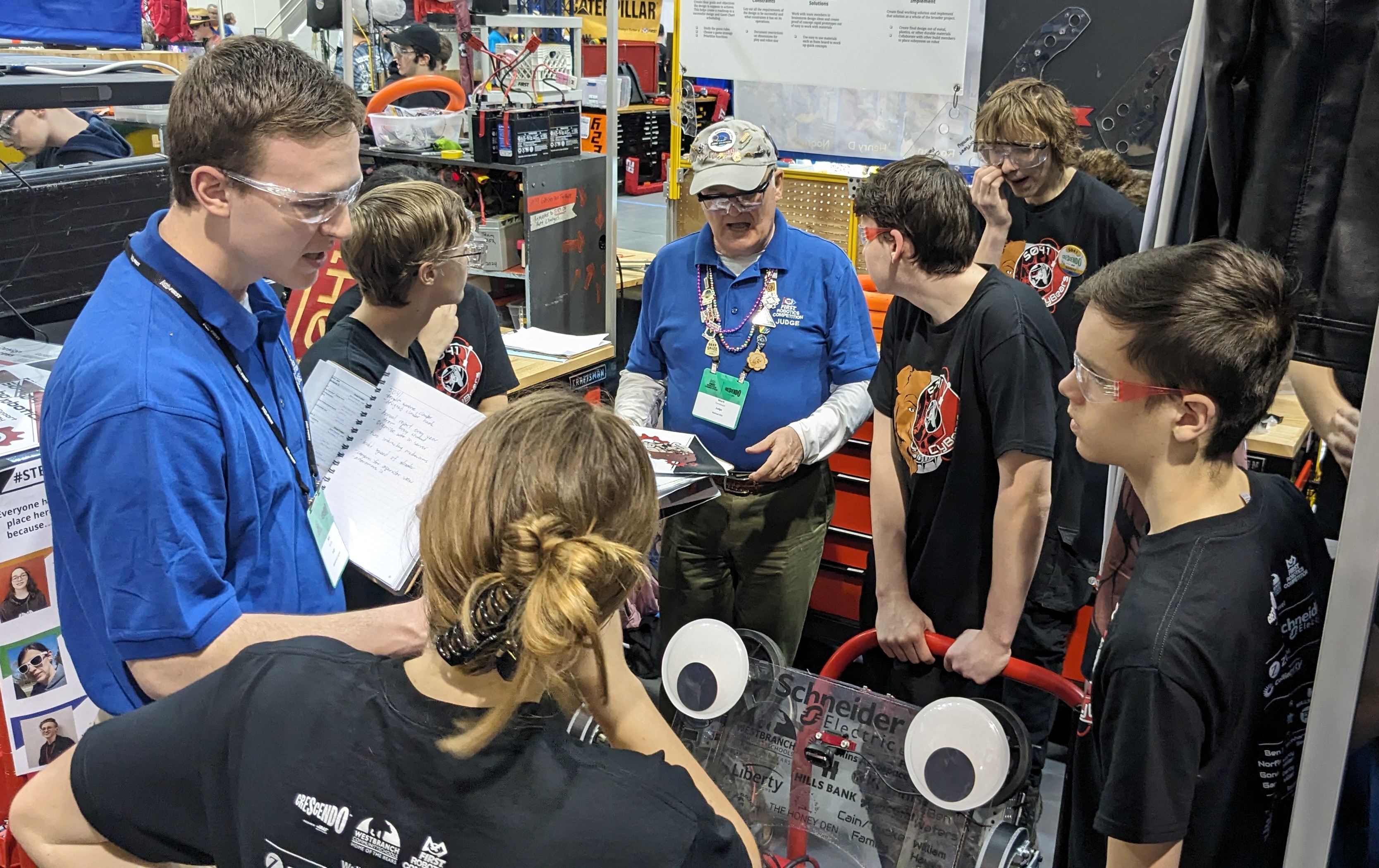
A strong pit interview often moves naturally between students who know different parts of the work.
Click an award to see what judges may want to hear
Click an award
Practice connecting your robot story to the award language.
Click an award to see what judges may want to hear
Click an award
Practice giving a specific story instead of a general statement.
Handouts and displays should jog memory, not replace talking
Short
Use one page or a very small packet. Judges cannot read a giant binder during pit visits.
Visual
Use pictures, diagrams, metrics, and before/after examples.
Focused
Feature your best machine story and best team story.
A handout should help judges remember your conversation after they leave the pit.
Scenario 1: “Tell us about your robot.”
Judge
“Tell us about your robot.”
Weak response
“It has swerve and shoots. We are pretty good at scoring.”
Strong response
“Our main design goal was fast, reliable cycles. We chose swerve for positioning, kept the intake simple, and designed the shooter to be serviceable. The biggest improvement was changing the intake roller spacing after testing because it reduced jams.”
Scenario 2: “What makes this mechanism unique?”
Judge
“What makes this mechanism unique?”
Weak response
“I don’t know, but it works. Our mechanical lead made it.”
Strong response
“The unique part is how the linkage folds inside the frame perimeter. We tested a longer arm first, but it was harder to protect. This version packages better and makes the robot easier to drive near defense.”
Scenario 3: “How do you support younger students?”
Judge
“How do you support younger students?”
Weak response
“We do outreach and help kids sometimes.”
Strong response
“We mentor FLL and FTC students so they have a pathway into high school robotics. High school students help with building, programming, and judging practice, which also trains our own members to teach engineering clearly.”
Scenario 4: “What went wrong this season?”
Judge
“What went wrong this season?”
Weak response
“Nothing really. Everything was fine.”
Strong response
“Our first prototype was too heavy and hard to repair. We learned to test earlier and redesigned the subsystem with fewer custom parts. That made it faster to build and easier for newer students to understand.”
Prepare the pit team
Pick 2 stories
- One robot story.
- One team story.
- Both should include evidence and results.
Assign experts
- Mechanical
- Electrical/control
- Programming
- Drive team strategy
- Outreach/sustainability
Practice answering in 30–60 seconds. Judges can ask follow-up questions if they want more.
Use this simple conversation checklist
- Greet judges professionally.
- Introduce yourself and your role.
- Answer the question asked.
- Use evidence from the robot or pit.
- Invite the right teammate to explain.
- Keep answers concise.
- Be honest about failures.
- Explain what students learned.
- Thank judges for visiting.
- Reset and be ready for the next group.
Pass to complete the module
Each question is on its own slide.
Answer all 20 questions, then grade the quiz. Score at least 18 out of 20 to unlock the completion slide.
Module Complete
Complete after passing the required quiz.
You are ready to practice a real pit judging conversation.